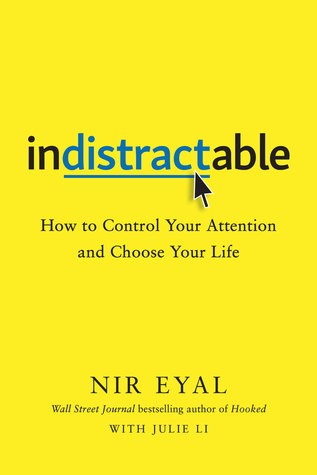
The Book in One Sentence
- Being indistractable is about understanding the real reasons why we do things against our best interests.
The Five Big Ideas
- Being indistractable is about learning to channel master feelings of dissatisfaction to make things better.
- To master internal triggers, learn how to deal with discomfort, observe urges and allow them to dissolve, and reimagine the trigger or task.
- To make time for traction, turn your values into time, schedule time for yourself and important relationships, and sync your calendar with stakeholders.
- To hack back external triggers, defend your focus, send fewer emails, get in and out of group chats at scheduled times, and turn off desktop and mobile notifications.
- To prevent distractions with pacts, plan for when you’re likely to get distracted, make unwanted behaviors more difficult, and call yourself “indistractable.”
Indistractable Summary
Living the good life requires not only doing the right things but also not doing the things we know we’ll regret. Being indistractable, according to Eyal, is about understanding the real reasons why we do things against our best interests.
Part 1: Master Internal Triggers
We can be indistractable by learning and adopting four key strategies:
- Mastering internal triggers;
- Making time for traction;
- Hacking back external triggers; and
- Preventing distractions with pacts
Key Takeaway
All motivation is a desire to escape discomfort. If a behavior was previously effective at providing relief, we’re likely to continue using it as a tool to escape discomfort. However, you can’t call something a “distraction,” unless you know what it is distracting you from.
Being indistractable, then, is about finding the root cause of distraction, rather than blaming proximate causes. Zoe Chance, a Professor of Yale University, escaped the pain of her impending divorce by racking up Striiv points on her pedometer.
To ensure our survival, we’re evolutionarily wired to feel easily dissatisfied. Without discontentment, we wouldn’t look for further benefits or advances.
Four psychological factors make satisfaction temporary:
- Boredom;
- Negativity bias;
- Rumination; and
- Hedonic adaptation.
Being indistractable is not about escaping from discomfort through distraction. Rather, it’s about learning to channel master feelings of dissatisfaction to make things better.
Resisting an urge can, ironically, trigger rumination and make the desire grow stronger.
We can manage distractions that originate from within by thinking differently about the trigger, the task, and our temperament. Furthermore, by reimagining an uncomfortable internal trigger, such as an urge to google something, we can disarm it.
The following four steps help handle intrusive thoughts:
- Look for the emotion preceding distraction;
- Write down the internal trigger;
- Explore the negative sensation with curiosity instead of contempt; and
- Be cautious during liminal moments.
Editor’s Note
One way to master internal triggers, says Ian Bogost, a professor at the Georgia Institute of Technology, is to reimagine an otherwise boring activity.
If you’re mowing the lawn, for example, instead of running away or rewarding yourself, look at the activity differently until you discover new challenges you didn’t see before (e.g., beating a record time).
To reimagine your temperament, Eyal advises:
- Avoiding believing willpower is limited;
- Labeling yourself as having self-control; and
- Practicing self-compassion.
Part 2: Make Time for Traction
To make traction, we need to examine how we spent our time. And to do that, we need to begin with our values. “Our values,” writes Russ Harris, are “how we want to be, what we want to stand for, and how we want to relate to the world around us.”
One effective way to make time for traction is through “timeboxing” which involves setting an “implementation intention.”
Further Reading
Eyal recommends revising your schedule regularly but committing to it once it’s set. Once you schedule time for yourself, synchronize your calendar with stakeholders to ensure they don’t distract you with superfluous tasks.
Part 3: Hack Back External Triggers
Contrary to belief, external triggers aren’t always harmful. Of each external trigger, ask: “Is this trigger serving me, or am I serving it?” Does it lead to traction or distraction? If it’s the former, it serves you.
“Time spent communicating should not come at the sacrifice of time spent concentrating,” writes Eyal. “Group chat is great for replacing in-person meetings but terrible if it becomes an all-day affair.”
To minimize mobile distractions, Eyal advises:
- Uninstalling the apps you no longer need;
- Shifting where and when you use potentially distracting apps to your desktop instead of your phone;
- Moving any apps that may trigger mindless checking from your phone’s home screen; and
- Changing the notification settings for each app.
When reading online, save interesting content for later using an app like Pocket. Or, use “multichannel multitasking,” like listening to articles while working out.
Part 4: Prevent Distraction with Pacts
Precommitments keep you from feeling distracted by removing a future choice. However, they should only be used after the other three indistractable strategies have already been applied.
There are three kinds of precommitment you can use to keep yourself on track:
- Effort pact;
- Price pacts; and
- Identity pacts.
An effort pact prevents distraction by making unwanted behaviors difficult to do. For example, using a Chrome extension like StayFocused to block websites like Facebook and Reddit.
A price pact adds a cost to getting distracted. However, you need to be aware of the following three pitfalls:
- Price pacts aren’t good at changing behaviors with external triggers you can’t escape (e.g. nail biting);
- Price pacts should only be used for short tasks; and
- Entering a price pact is scary.
An identity pact is a precommitment to a self-image.
Further Reading
Recommended Reading
If you likeIndistractable, you might also like:
- Atomic Habits: Tiny Changes, Remarkable Resultsby James Clear
- Deep Work: Rules for Focused Success in a Distracted Worldby Cal Newport
- Decisive: How to Make Better Choices in Lifeby Chip Heath and Dan Heath
Buy The Book: Indistractable
Related Lists
- Business Book Summaries
- Psychology Book Summaries
- Self-Help Book Summaries
Or,browse more book summaries.
Back to All Book Summaries